Immigration Tensions Rise in Dallas: The H1B Visa Debate Heats Up

Immigration Tensions Rise in Dallas: The H1B Visa Debate Heats Up

Reading Time: 2 minutes

A recent viral post has sparked a heated debate regarding immigration and H1B visas in Dallas.

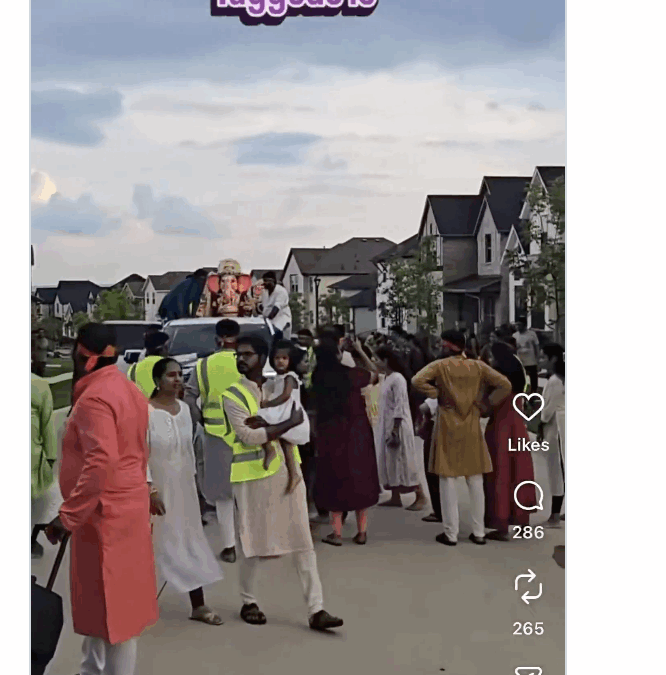
The post, which showcased an old festival footage of a Ganesh Chaturthi procession in a Dallas-area suburb, has caused controversy online. The video depicts men and women dressed in traditional Indian attire playing drums and celebrating in a shopping center car park. The caption of the post claims that Dallas is turning into “Dallaspuram” and blames the visa system for this transformation. It suggests that H1B visas are being misused to import Indian workers for basic jobs that could be done by Texans and criticizes these workers as not being top global talent.

However, it is important to note that the video is not recent and dates back to August 2025. It was filmed during Ganesh Chaturthi celebrations in Lewisville, a suburb known for its large Indian community. While Hindu Americans described the event as a cultural celebration, some members of the community complained about the disruption caused by the procession in a commercial parking area. The broader debate surrounding immigration and the H1B visa program has now taken center stage, with conflicting viewpoints on its impact. While many argue that skilled migration has benefited the local economy and key sectors like technology and defense, others believe it takes away jobs from US workers and offers them to foreign workers at lower salaries. The Dallas-Fort Worth metro area is home to a significant Indian American population, with many residing in suburbs like Frisco, Plano, and Lewisville.

The region has become a hub for technology and business, attracting skilled migrants from around the world.

As tensions continue to rise, recent discussions at a city council meeting in Frisco highlighted fears of an “Indian takeover” of the region. The ongoing debate underscores the challenges surrounding immigration and work visas in the current political climate.

here is the viral post – 

President Trump’s New Law: How the Visa Integrity Fee Will Change Travel to the US for Indians

President Trump’s New Law: How the Visa Integrity Fee Will Change Travel to the US for Indians

Reading Time: < 1 minute

Under this bill, the cost of a US visa will increase by 2.5 times starting in 2026. Travelers visiting the country will be required to pay a non-refundable integrity fee of USD 250.

This development is expected to impact Indian students and IT professionals traveling to the US for educational and employment purposes. Furthermore, the fee may be adjusted annually based on the inflation rate. Previously, obtaining an American visa was relatively straightforward for students, IT professionals, and tourists, with minimal financial impact. However, with the implementation of the One Big Beautiful Bill, traveling to the US is poised to become a significant financial burden for travelers.

President Donald Trump signed this new law on July 4, with the intention of making America “great again.” The Visa Integrity Fee, amounting to USD 250 (approximately Rs 21,400), will be enforced starting in 2026 and will not be refundable.

It is important to note that this fee is subject to change each year based on inflation rates. The Visa Integrity Fee is part of a broader reform in travel-related fees, including a USD 24 fee on I-94, a USD 13 cost in the Visa Waiver Program, and a USD 30 EVUS tax imposed on Chinese citizens. Currently, US B-1/B-2 visa fees stand at USD 185, with a significant increase expected in 2026.

US Immigration Unveils Trial Initiative for H-1B Visa Renewals on American Soil

US Immigration Unveils Trial Initiative for H-1B Visa Renewals on American Soil

Reading Time: 2 minutes

The United States is gearing up to launch a pilot program in December focused on the in-country renewal of specific categories of H-1B visas. This initiative is expected to bring considerable advantages to numerous Indian technology professionals, according to information provided by US officials.

The decision to roll out this program comes on the heels of the White House’s announcement during the state visit of Prime Minister Narendra Modi in June. Julie Stufft, Deputy Assistant Secretary of State for Visa Services, underscored in an interview with news agency PTI the ongoing high demand for US visas in India. She expressed concerns about prolonged wait times—six, eight, and 12 months—that do not align with their perspective on India.

Commencing in December, the State Department aims to issue 20,000 visas over a three-month period, primarily targeting Indian nationals already residing in the US. This move is poised to significantly benefit India, given its standing as the largest skilled group of workers in the United States.

The program’s primary goal is to eliminate the need for individuals to travel back to India or elsewhere for visa renewal appointments. This, in turn, allows US missions in India to prioritize new applicants. Although the State Department has been actively developing the pilot program for some time, the formal announcement took place during Prime Minister Narendra Modi’s visit. The plan, initially mentioned in the joint statement and later disclosed by PM Modi during his address to the Indian diaspora at the Ronald Reagan Centre, has received positive feedback from the Indian community in the US.

Julie Stufft explained that a federal register notice, serving as the first official communication of the program, will be released shortly. This notice will delineate the necessary steps, eligibility criteria for the first tranche of applications, and provide detailed instructions. It’s crucial to note that the domestic visa renewal program specifically applies to work visas.

“This is an existing regulation that was allowed that we just have not used in about 20 years. These are work visas. It is intended for people who are living long-term in the US but want to renew their visa without going back overseas,” stated Julie Stufft.

Characterizing it as a “huge undertaking,” she expressed enthusiasm about the pilot program, set to commence with 20,000 cases in December, January, and February. The State Department is eager to expand the program to include more categories of workers residing in the United States throughout 2024.

Indian-American community leader Ajay Jain Bhutoria hailed the State Department’s move as “significant.” In his capacity as the commissioner to the President’s Advisory Commission on Asian Americans, Native Hawaiians, and Pacific Islanders, Bhutoria presented a proposal, accepted and recommended by US President Joe Biden.

“I am happy to see the recommendation I presented on behalf of immigration subcommittees on the Commission for H-1B visa stamping in the USA finally being implemented,” Bhutoria remarked. He highlighted that this relief will ultimately benefit over one million H-1B holders, with a substantial number being Indians.

The Surge Continues: Record Number of Indian Students Opt for the US, Reveals Open Doors 2023 Report

The Surge Continues: Record Number of Indian Students Opt for the US, Reveals Open Doors 2023 Report

Reading Time: 2 minutes

The Open Doors 2023 report has revealed a significant increase in the number of Indian students choosing to stay back in the US on OPT (optional practical training) after completing their academic studies. According to the report, India has become the second leading country for students studying in the US, with the number of Indian students reaching an all-time high of 268,923 in 2022-23, marking a 35% increase from the previous year.

The report, released by the US department of state’s bureau of educational and cultural affairs and the Institute of International Education (IIE), also highlighted the robust growth in the number of Indian graduate students, which saw a 63% increase. Additionally, there was a 16% increase in the number of Indian undergraduate students choosing to study in the US.

The surge in the number of Indian students in the US was largely driven by the growing interest in STEM subjects, particularly maths and computer science. Despite concerns about job losses and lower job opportunities in the US, the report indicated that there has been a steady increase in the number of Indian students opting to stay back in the country on OPT.

Dr. Mirka Martel, head of research, evaluation & learning at IIE, emphasized that the data continues to indicate robust growth and interest from Indian students to continue their studies in the US. She also noted that there has been a 17% increase in the overall number of international students on OPT, indicating a strong rebound of international graduates pursuing post-study work opportunities.

Furthermore, the report highlighted that US institutions have reported increases in new Indian student enrolment, with over half of higher education institutions stating that they have more new Indian students this fall than they had a year ago. This trend is expected to continue, with US higher education institutions reporting an 8% increase in international students in Fall 2023, across all academic levels and OPT.

Marianne Craven, acting deputy assistant secretary for academic exchanges, bureau of educational and cultural affairs, US department of state, emphasized the importance of the education relationship between the United States and India, highlighting the significant increase in student visas issued in mission India.

The report also indicated a 14% increase in the number of international students enrolling for the first time at a US college or university during the 2022-2023 academic year, building on the 80% increase in the prior year. This growth was particularly notable in graduate student enrolment, with 467,027 international students pursuing master’s, doctorate, or professional degrees, marking a 21% increase year-over-year.

Overall, the Open Doors 2023 report paints a positive picture of the growing interest and participation of Indian students in the US education system, despite concerns about job losses and lower job opportunities. The report’s findings indicate a strong and enduring relationship between the United States and India in the field of education, with both countries continuing to strengthen ties and promote academic cooperation.

As the number of Indian students in the US continues to soar, it is evident that the US remains a top destination for Indian students seeking higher education and career opportunities. With the ongoing growth and momentum in international student mobility, the future looks promising for Indian students pursuing their academic and professional aspirations in the US.

US visa wait time still over 500 days! Delhi to Mumbai, list of cities with longest, shortest wait period

US visa wait time still over 500 days! Delhi to Mumbai, list of cities with longest, shortest wait period

Reading Time: 2 minutes

Despite the U.S. government’s efforts to expedite visa processing in India, wait times can still exceed 500 days.As per the Department of State- Bureau of Consular Affairs website, currently the wait time for B1/B2 non-immigrant visitor visa appointments in different cities varies between 506 days and 596 days. However, this is a significant drop from the 1,000-day waiting period earlier this year.
The B1 visa covers business-related travel to the US, meanwhile, the B2 visa is for tourism, medical treatment, and social events. Both can be issued together so that the applicants can travel for both business and pleasure.

Here is the estimated wait time from your city:
New Delhi: 542 days
Mumbai: 596 days
Kolkata: 539 days
Chennai: 531 days
Hyderabad: 511 days
However, for H-1B visa or an F1 visa, the wait times are much shorter. Typically, the wait time can range between 2 days to 90 days.

Over the past year, efforts were made to address the extended wait times, which had reached almost three years last winter. To address the visa application backlog and meet rising demand, Indians were given the opportunity to apply for U.S. visas at U.S. consulates located outside India, like the one in Bangkok, where the visa wait time is significantly lower.

Last month an embassy official said, as reported by TOI, “In India, all non-immigrant visa categories, except first-time visitor visa applicants, have interview wait times close to pre-pandemic levels or lower. We have significantly increased the number of visas issued across the board…. Wait times for travelers who do not require an interview are very low.”

US govt planning to overhaul H1B visa programme
Last week, the Joe Biden administration proposed changes in the H-1B foreign workers programme to improve efficiency by streamlining eligibility, providing more flexibility to F-1 students, entrepreneurs and those working for non-profit bodies and ensuring better conditions for other non-immigrant workers. The rules have been proposed without changing the Congress-mandated 60,000 limit on the number of such visas the US issues every year.

Sri Lanka approves free visa scheme for India, China, Russia; US not on list

Sri Lanka approves free visa scheme for India, China, Russia; US not on list

Reading Time: < 1 minute

The Sri Lanka cabinet has approved a proposal to grant free visas to travelers from seven countries – India, China, Russia, Malaysia, Japan, Indonesia, and Thailand for five months, Sri Lanka’s minister of foreign affairs Ali Sabry announced on Tuesday. According to Sabry, the free visa travel has begun with immediate effect as a pilot project and will continue till March 31.

According to the tourism ministry of Sri Lanka, the purpose of this move is to attract more tourists to the country. “We are expecting to increase tourist arrivals to five million over the coming years,” the ministry said as quoted by the Sri Lankan media.

The move is also expected to save money and time spent on obtaining visas for the travellers.

Last week, the ministry of tourism announced that a proposal was presented in the Cabinet meeting to issue free tourist visas for travellers from five countries. The cabinet paper was reportedly presented jointly by Sri Lankan Prime Minister Dinesh Gunawardena, Tourism and Lands Minister Harin Fernando, Minister of Public Security Tiran Alles, and Minister of Foreign Affairs Ali Sabry.

The Cabinet also proposed to introduce an e-ticketing system for most of the tourist sites in the country in the near future, the ministry said, reported local media.