Illegal immigration from India to US surged in last 2 months, doubled in 2021-22

Illegal immigration from India to US surged in last 2 months, doubled in 2021-22

Reading Time: 4 minutes

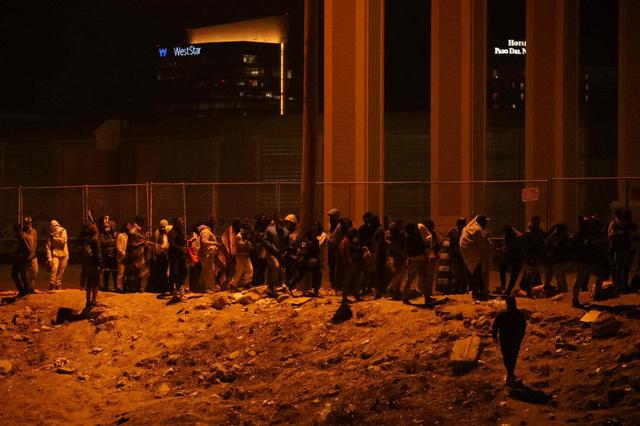
The death of an Indian man who fell trying to climb a border wall into Texas has put a spotlight on illegal immigration from India to the US which has shown a sudden surge along the border with Mexico in the last two months.

US Border Patrol caught 4,297 Indians crossing the Mexican border in October and November, compared to 1,426 during those two months last year and 16,236 in all of the fiscal year that ended in September, according to American government data.

Overall, the number of Indians apprehended by US authorities right on the border and elsewhere has more than doubled since last year.

US authorities encountered 63,927 Indians who had entered the country illegally, during the 2021-22 fiscal year that ended in September, a 109 per cent increase from the 30,662 they found the previous fiscal year, according to Customs and Border Protection (CBP) data.

In just the last two months, a total of 13,655 illegal immigrants from India were caught compared to 6,865 during those two months in 2021, the data showed.

In the fiscal year 2019-20, the number of Indians illegally in the US who were apprehended by the CBP was only 19,883, according to the agency.

Indians are only a part of the phenomenon of Illegal migration to the US that has been spiralling since the election of President Joe Biden and Vice President Kamala Harris, who has been tasked to stop the flow of migrants from Latin America.

Although Harris has asserted that the border is “secure”, US authorities have registered 2.77 million encounters with people of different nationalities illegally in the US during the fiscal year that ended in September, up 41 per cent from the 1.96 million in the previous period.

In 2019-20, there were only 646,822 encounters.

The Biden administration which has been struggling to cope with the surge of people trying to enter the US illegally at the southern border received a reprieve from the Supreme Court on Tuesday, even though it glibly opposed it.

Biden had kept in place a rule instituted as a health measure because of the Covid-19 pandemic by his predecessor Donald Trump to return Latin Americans from most countries to Mexico when they are caught but revoked it in May under pressure from his Democratic Party’s left.

A group of Republican state officials went to court against it and the Supreme Court temporarily stayed the revocation till February, staving off an expected rush to the border.

The rule known as Title 42 is not used against Indians and people from outside Latin America as Mexico will not take them back.
The illegal migration numbers are only of those caught by the CBP and several more would have successfully evaded authorities those who entered legally but overstayed their visas making their presence in the country illegally are not included in the data.

In the 2019-20 fiscal year, the latest period for which data is available, 14,389 Indians were suspected of overstaying, up from 13,203 the previous year, according to the Department of Homeland Security (DHS).

On the northern border with Canada, where an Indian family of four were found frozen to death about a dozen metres from the US border in January, 84 Indians have been apprehended in the last two months.

During the US fiscal year ending September 237 Indians had been caught there, compared to 42 in the previous 12 months and 129 in the period before that.

Most of those caught by US authorities is released, usually with a notice to appear before an immigration judge, but with little or no follow-up and few are detained.

A breakdown by nationality of how those caught by the CBP were dealt with was not available.

According to data from the Transactional Records Access Clearinghouse (TRAC), a database maintained by Syracuse University, 34,230 asylum cases of Indians were pending before Immigration courts last month.

People can ask for asylum on various grounds including fear of religious or political persecution, domestic violence and threats due to sexual orientation but will have to prove it to a judge.

In the fiscal year 2019-20, the latest period for which data is available from the Homeland Security Department, 1,337 Indians were granted asylum, down from the 2,256 who received it the previous year.

In 2017-18, 1,302 Indians received asylum, according to the Department.
A breakdown of reasons for granting asylum was not available.

TRAC provides a breakdown by languages spoken by those whose asylum cases are pending and Punjabi-speakers, who could be from India or Pakistan or elsewhere, numbered 21,961.

There were 6,770 Hindi-speakers, 6,315 Bengali-speakers, who could be from India or Bangladesh or elsewhere, and 376 Tamil-speakers, who could be from India, Sri Lanka or other countries.

In addition, TRAC listed 222 Haryanvi-speakers, 166 Telugu-speakers and 32 Marathi-speakers.
According to Immigration and Customs Enforcement, 2,312 Indians were deported from the US during 2019-20, and 1,616 in 2018-19.
The deaths at the border of Indians involved families, but most of the Indians apprehended by US officials are single adults. They constituted 56,739 of those caught in 2021-22 and 11,780 in the last two months.

Those who came in as families were 6,577 in the last fiscal year and 1,736 in the last two months.

Brijkumar Yadav fell to his death on December 14 while holding his three-year-old son and climbing the border wall built by the Trump administration between San Diego and Mexico.

His wife also fell, but on the US side and survived and the child was reunited with her, according to reports.
On the border with Canada, Jagdishkumar Patel, 39, his wife Vaishaliben, 37, and their daughter Vihangi, 11, and son Dharmik, 3, were found frozen to death on January 19.
Good news for H1b holders and who lost their jobs

Good news for H1b holders and who lost their jobs

Reading Time: 2 minutes

Nonimmigrant workers who have lost jobs may have several options for remaining in the United States in a period of authorized stay based on existing rules and regulations, according to US Citizenship and Immigration Services (USCIS).

Regulations permit a discretionary grace period that allows workers in E-1, E-2, E-3, H-1B,

H-1B1, L-1, O-1, or TN classifications (and their dependents) to be considered as having maintained status following the cessation of employment for up to 60 consecutive calendar days or until the end of the authorized validity period, whichever is shorter (See 8 CFR 214.1(l)(2)).

During this period, workers may be able to maintain their nonimmigrant status if a new employer timely files a petition on their behalf with an extension of stay request (e.g., an H-1B change of employer petition for a worker in H-1B status).

Portability rules permit workers currently in H-1B status to begin working for a new employer as soon as the employer properly files a new H-1B petition with USCIS, without waiting for the petition to be approved. More information about H-1B portability can be found on our H-1B Specialty Occupations page.

Workers may use the up to 60-day discretionary grace period to apply to change their nonimmigrant status, which may include changing status to become the dependent of a spouse (e.g., H-4, L-2).

Workers may use the up to 60-day discretionary grace period to seek a new employer-sponsored nonimmigrant status in the same or different status.

Some workers may be eligible to file a self-petitioned immigrant visa petition concurrently with an adjustment of status application.

Workers who are the beneficiary of an approved employment-based immigrant visa petition (Form I-140) may be eligible for a compelling circumstances EAD for up to one year if they:

  • do not have an immigrant visa available to them in the Department of State’s Visa Bulletin, and
  • face compelling circumstances.

For precise news on various options , refer the USCIS page -https://www.uscis.gov/newsroom/alerts/options-for-nonimmigrant-workers-following-termination-of-employment

US starts ’12 Days of Visas’ program in India

US starts ’12 Days of Visas’ program in India

Reading Time: < 1 minute

The US Embassy in New Delhi has begun with a ’12 Days of Visas’ program encouraging Indian professionals to check out on H&L work visas. Tuesday marked day one of the campaign which will continue until Christmas.

A video clip shared by the embassy on their social media handles noted that there was a 17% increase in the H&L visa applications and the waiting time for the same has been reduced. It said that this means tens of thousands of workers and families have been able to reunite or start working in the US.

“We are starting with #12DaysofVisas today! Check out day 1 on H&L visas,” the embassy tweeted Tuesday.

The L1 visa is reserved for managerial or executive professionals transferring to the US from within a US-based company or a company opening up its operations in the US.

H-1B visa coveted by Indian tech professionals is needed when a US-based company hires high skilled professional. L1 and H-1B are the most common types of work visas in the US.

In recent years, more than two thirds of 80,000 H-1B work visas, including 20,000 for those with masters degrees from US institutions, have gone to Indians.

US Embassy also shared that this year also marks the 100th anniversary of the White House Christmas tree ceremony.

“This year marks the 100th anniversary of the @WhiteHouse Christmas tree ceremony! The tree lighting has brought holiday joy and cheer to millions over the years. Join us in taking a peek at the history of the #WhiteHouseChristmasTree. https://bit.ly/3P4Jmxh

“The White House@WhiteHouse

The National Christmas Tree Lighting – a White House tradition for 100 years,” it tweeted.

New policy of USCIS will automatically extend green cards for naturalization applicants

New policy of USCIS will automatically extend green cards for naturalization applicants

Reading Time: 2 minutes

US Citizenship and Immigration Services (USCIS) will automatically extend the validity of Permanent Resident Cards or green cards for lawful permanent residents who have applied for naturalization(the admittance of a foreigner to the citizenship of a country) starting Dec 12.
The new update of USCIS Policy Manual is expected to help naturalization applicants who experience longer processing times, because they will receive an extension of lawful permanent resident (LPR) status and may not need to file Form I-90, Application to Replace Permanent Resident Card (green card).
LPRs who properly file Form N-400, Application for Naturalization, may receive this extension without regard to whether they filed Form I-90, USCIS said in a press release.
USCIS said it will update the language on Form N-400 receipt notices to extend green cards for up to 24 months for these applicants.

The receipt notice can be shown with the expired green card as proof of continued status as well as identity and employment authorization under List A of Employment Eligibility Verification (Form I-9), if presented before the expiration of the 24-month extension period provided in the notice.
Prior to this change, under USCIS policy, naturalization applicants who did not apply for naturalization at least six months before their green card expiration date needed to file Form I-90 to maintain proper documentation of their lawful status.
Applicants who applied for naturalization at least six months prior to their green card expiration were eligible to receive an Alien Documentation, Identification, and Telecommunications (ADIT) stamp in their passport, which served as temporary evidence of their LPR status.
This policy was based on the processing goal of 180 days or six months for Form N-400s, which would make filing Form I-90 unnecessary for applicants who filed at least six months before their green card expiration date.
The new policy update recognizes USCIS’ current processing times, while improving flexibility and efficiency by reducing the number of ADIT stamp appointments in field offices and the number of Form I-90s filed, which allows for these resources to be focused on other immigration benefit adjudications, USCIS said.
The extension will apply to all applicants who file Form N-400 on or after Dec 12, 2022. LPRs who filed for naturalization prior to Dec 12 will not receive a Form N-400 receipt notice with the extension.

If their green card expires, they generally must still file Form I-90 or receive an ADIT stamp in their passport, in order to maintain valid evidence of their lawful permanent resident status.
Lawful permanent residents who lose their green card generally must still file Form I-90, even if they have applied for naturalization and received the automatic extension under this updated policy.
This is because noncitizens must carry within their personal possession proof of registration, such as the green card and any evidence of extensions or may be subject to criminal prosecution under INA 264(e), USCIS said.
Applicants who need an ADIT stamp may request an appointment at a USCIS Field Office by contacting the USCIS Contact Center

Indian-Americans To Benefit From US Bill That Ends Per Country Quota

Indian-Americans To Benefit From US Bill That Ends Per Country Quota

Reading Time: 3 minutes

The White House has supported Congress to pass a legislation that seeks to eliminate the per country quota on green cards to allow US employers to focus on hiring people based on merit, not their birthplace, a bill if passed would benefit several hundreds of thousands of immigrants specially Indian-Americans.
A Green Card, known officially as a Permanent Resident Card, is a document issued to immigrants to the US as evidence that the bearer has been granted the privilege of residing permanently.

This week, the House of Representatives is scheduled to vote on the Equal Access to Green Cards for Legal Employment (EAGLE) Act of 2022.

The EAGLE Act would eliminate a per-country cap on employment-based green cards- a policy that disproportionately affects Indian immigrants.

If passed, this legislation would phase out the per-country caps over the course of nine years to ensure that eligible immigrants from less populated countries are not excluded as the EAGLE Act is implemented.

“The administration supports efforts to improve our immigrant visa system and ease the harsh effects of the immigrant visa backlog,” the White House said.

“Accordingly, the administration supports the House passage of HR 3648, the Equal Access to Green Cards for Legal Employment (EAGLE) Act, and its goal of allowing US employers to focus on hiring immigrants based on merit, not their birthplace, by eliminating the “per country” limitation on employment-based immigrant visas (green cards),” it said.

These changes would take effect over a nine-year transition period to ensure that no countries are excluded from receiving visas while the per-country caps are phased out.

During the transition period, visas would also be set aside for nurses and physical therapists to address urgent needs in the healthcare industry, and for employment-based immigrants and their family members who are not currently in the United States, the White House said.

“This legislation would be life-changing for hundreds of thousands of immigrants currently stuck in legal limbo as they wait for green cards,” said Neil Makhija, executive director of the Indian American Impact.

The per-country cap on green cards is a relic of a discriminatory system that excluded Asian immigrants entirely in the past, he said.

“The caps were enacted decades ago and do not reflect our country’s values. It is time for Congress to act and provide fair and equitable treatment to so many immigrants who call this country home,” Makhija said.

The bill among other things also includes important provisions to allow individuals who have been waiting in the immigrant visa backlog for two years to file their green card applications, the White House said.

Although the applications could not be approved until a visa becomes available, this would allow employment-based immigrants to transition off of their temporary visas and provide them with additional flexibility in changing employers or starting a business, it said.

Importantly, the bill would also keep families together by ensuring that children of employment-based immigrants do not age out of dependent status or lose their eligibility for a green card, the White House noted.

The White House said for generations, immigrants have contributed to key sectors of the US economy and fortified America’s most valuable competitive advantage- the spirit of innovation and entrepreneurship.

“Immigrants keep our economy growing, our communities thriving, and our country moving forward,” it said.

In addition to passing HR 3648, the administration urges Congress to pass the US Citizenship Act, which would further reform and improve the immigrant visa system by increasing lawful pathways to the United States, providing a path to citizenship to millions of undocumented immigrants, and establish a new system to responsibly manage and secure our border,” said the White House.

US starts ’12 Days of Visas’ program in India

US opens new visitor visa appointment slots in India

Reading Time: < 1 minute

To facilitate holiday travel, the United States has opened a number of new appointment slots for B1/B2 visa applicants, who are eligible for interview waivers, for December in Delhi, Mumbai and Chennai.

“Looking for a B1/B2 interview waiver (dropbox) visa appointment? Good news! We’ve opened a number of B1/B2 interview waiver appointments for the coming month in Delhi, Mumbai and Chennai. Book now in time for holiday travel,” the US Embassy in New Delhi tweeted on Monday.

The current wait time for an appointment for B1/B2 interview waiver appointments is 233 days in Delhi, 297 in Mumbai and 171 days in Chennai. Applicants can opt for the interview waiver program if they are renewing any visa (including B1/B2 visas) within 48 months of expiration.

For first-time applicants for the US business (B-1) and tourist (B-2) visitor visas, wait time has touched almost three years, for those not eligible for interview waivers. “The global median wait time for a tourist visa (B1/B2) interview appointment is under two months as of this month,” according to the US State Department.

To address the growing backlog, the US has made more applicants eligible for interview waiver, sending drop box cases abroad for adjudication and getting temporary staffers.

While students get top priority in admission season, next on the list is expediting drop box cases for skilled workers, repeat B1/B2 visa seekers (whose visas expired within four years of application that now makes them eligible for interview waiver) and crew. It could possibly be several months before the interview wait time for B1/B2 starts dropping.

The US expects the processing times to rebound faster than projected and expects it to reach pre-pandemic levels in Fiscal Year 2023.