U.S. immigration agency moves to cut 9.5 million-case backlog and processing delays

U.S. immigration agency moves to cut 9.5 million-case backlog and processing delays

Reading Time: 2 minutes

The Biden administration on Tuesday is announcing three measures to reduce a growing multimillion-case backlog of immigration applications that has crippled the U.S. government’s ability to process them in a timely fashion, a senior U.S. Citizenship and Immigration Services (USCIS).

The agency plans to expand the number of applicants who can pay extra fees to have their immigration petitions adjudicated more quickly, propose a rule that would provide relief to immigrants waiting for work permit renewals and set processing time goals, the official said, requesting anonymity to detail the measures before a formal announcement.

USCIS adjudicates requests for work permits, asylum, green cards, U.S. citizenship and other immigration benefits, including the temporary H-1B program for highly skilled foreign workers and the Deferred Action for Childhood Arrivals (DACA) policy for undocumented immigrants brought to the country as children

The agency, which is largely funded by fees, has struggled with application bottlenecks and processing delays for years. But the COVID-19 pandemic, which initially led to a shutdown of most global travel, a drop in applications and a suspension of in-person interviews and other services, greatly exacerbated those issues.

As of February, USCIS was reviewing more than 9.5 million pending applications, a 66% increase from the end of fiscal year 2019, according to agency data.

The growing case backlog has dramatically extended application processing delays, trapping many immigrants — from asylum-seekers and green card applicants to would-be U.S. citizens — in a months- or years-long legal limbo that can force them to lose their jobs, driver’s licenses and sources of income.

“USCIS remains committed to delivering timely and fair decisions to all we serve,” USCIS Director Ur Jaddou said Tuesday. “Every application we adjudicate represents the hopes and dreams of immigrants and their families, as well as their critical immediate needs such as financial stability and humanitarian protection.”

what are the new measures?

Among USCIS’s new measures is a rule to expand “premium processing,” which allows certain applicants to pay $2,500 in extra fees to have their cases reviewed on an expedited basis. Currently, the service is limited to certain applications, including H-1B petitions and some employment-based green card requests.

The rule, set to take effect in 60 days, will expand premium processing to additional employment-based green card applications, all work permit petitions and temporary immigration status extension requests, allowing applicants to pay $2,500 to have their cases adjudicated within 45 days.

Premium processing will expand gradually, starting with work-based green card petitions for multinational executives or managers and professionals with advanced degrees or “exceptional ability” who are requesting a waiver that allows them to immigrate to the U.S. without having a job offer, which is typically required.

The senior USCIS official said the phased implementation will ensure other applications are not delayed by the premium processing expansion, which was authorized by Congress in 2020, when the agency faced a fiscal crisis that threatened to furlough 13,000 employees.

“We can’t just shift all our resources to premium filers, while everybody else suffers,” the official said.

“We Are Americans”: Indian-American ‘Dreamer’ to US lawmakers

“We Are Americans”: Indian-American ‘Dreamer’ to US lawmakers

Reading Time: 4 minutes

An Indian-American documented dreamer has told lawmakers that she is an American and hopes to be recognised as one and not forced to leave the US in eight months in the absence of any meaningful legislative reforms in the immigration system that addressed the issue of aged out kids. Documented dreamers are children who come to the United States as dependants of their parents – who themselves have legal permit to work in the US, like holding the H-1B foreign work visa. When these children turn 21 years of age, they lose their dependency status.

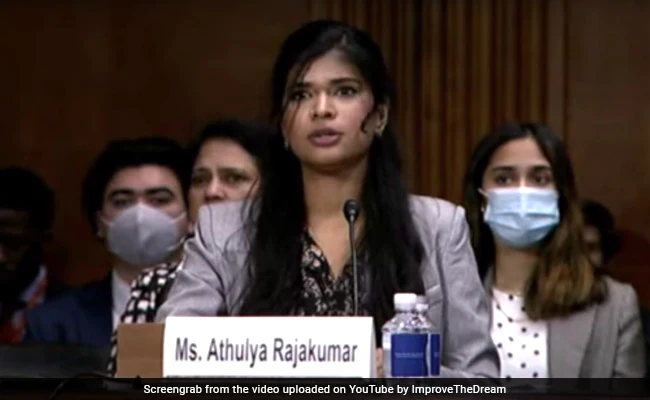
“Without a change in eight months, I will be forced to leave, not only my home of 20 years but also my mom who is my only family left,” Athulya Rajakumar, a 23-year-old recent graduate of the University of Texas at Austin from the Moody College of Communication, told members of the Senate Judiciary Subcommittee on Immigration, Citizenship and Border Safety on Tuesday.

Testifying before the subcommittee during a hearing on “Removing Barriers to Legal Migration,” the Indian-American told the Senators that over 5,000 documented dreamers face this every year.

“We are Americans, and all we hope is to be recognised as that, to finally give meaning to the lives we have lived here so far. I hope you can improve the dream for all of us,” Ms Rajakumar said.

“I learned very young that every aspect of my life would be controlled by my status,” she said.

“Erin, a nursing graduate was forced to self-deport last summer in the midst of a pandemic,…a data analyst student was forced to self-deport two months ago, Summer will be forced to self-deport in four months, even though her family has legally resided here since she was a baby,” she said.

An aspiring journalist, Ms Rajakumar, from Washington State, shared the story of her family’s struggle through years of immigration limbo, which contributed to her brother’s tragic death.

“I’m outraged by this broken system that you, your brother, and thousands of documented dreamers have had to face. We organised this hearing today because we cannot allow the inaction of Congress to continue to cause this suffering,” Senator Alex Padilla said in his remarks.

Mr Padilla is chair of the Senate Judiciary Subcommittee on Immigration, Citizenship, and Border Safety, Barriers to legal migration routinely separate families across international borders for years, he said.

“Visa caps that keep employers from expanding their businesses and hold back the US economy, an arbitrary cutoff for legal status that forced children, visa holders, to leave the only country they’ve ever known when they age out of their parents’ visas. The gap between our country’s needs and the realities of our broken immigration system should come as no surprise,” Mr Padilla said.

According to the Senator, currently, there’s a backlog of 1.4 million people who are eligible for employment-based visas.

“Employment-based visas allow participating immigrants to bring extraordinary skills to our workforce, start new businesses, create new jobs in rural areas, and to help address worker shortages in industries like health care,” he said.

“But only 140,000 of these individuals can obtain visas every year. Because the spouses and children who accompany them count against the total, far fewer than 70,000 visas actually go to eligible workers. Hundreds of thousands of others are left in limbo, restricted by a temporary visa, or turned away from their dreams and they’re kept from realising their potential,” he said.

Ranking Member Senator John Cornyn said the Congressional Research Service recently estimated that without significant changes, the employment-based green card backlog could exceed 2 million by 2030.

Employment-based visas, also known as green cards, allow migrants to gain lawful permanent residence in the US in order to engage in skilled work.

“Indian nationals have been hit especially hard because our system’s per-country caps do not allow them to receive more than seven per cent of the available employment-based visas in any given year,” he said.

“To make matters worse due to processing inefficiencies attributable in part to USCIS’ paper-based system and to the closures of many of our consulates, we fail to issue as many as 92,000 employment-based visas in the height of the pandemic,” he said.

Ms Rajakumar told lawmakers that she got a full-time offer from a major news corporation in Houston, a top 10 market, but the same company who saw her potential withdrew their offer the second they heard about her visa status. “But worst of all, being considered an alien, an outsider in the only place you know to call home is a different kind of pain,” she said.

Dip Patel, president of Improve The Dream, in a statement, said that Ms Rajakumar’s moving testimony shows the urgent need to update the broken system, including the need to permanently end the problem of aging for children who are raised and educated in the United States.

“For thousands of young people growing up with uncertainty, there is constant anxiety regarding one’s future in what we consider our home. Delay in taking action will not only lead to tearing more families apart but also continue the immense emotional turmoil faced by thousands of families who contribute to our country and call America home. We urge Congress to consider this and act fast to pass common-sense immigration reform,” he said.

During the hearing, Mr Padilla questioned Ms Rajakumar about her experience as a documented dreamer and how a pathway to citizenship and the enactment of America’s Children Act would impact her life.

Ms Rajakumar pointed to the fact that it would mean that she wouldn’t have to be separated from her family and the country she’s called her home for the last twenty years.

The H-1B visa is a non-immigrant visa that allows US companies to employ foreign workers in speciality occupations that require theoretical or technical expertise. The technology companies depend on it to hire tens of thousands of employees each year from countries like India and China.

India to restore some old, valid tourist visas for US nationals

India to restore some old, valid tourist visas for US nationals

Reading Time: < 1 minute

The Government of India announced that they will restore some old, valid tourist visas for US nationals with immediate effect, Consulate General of India in Chicago said in a press release on Tuesday.

The press release stated that the fresh issue of regular (papers) long-duration (10 years) tourist visas have been restored for US nationals.

It also reads that the e-tourist visas under three options (one month, one year and five years), which was suspended since March 2020, shall be restored. And the application for fresh e-tourist visas for eligible nationals can now be made at the Indian E-visa portal.

While the current scheme of regular tourist visa/e-visa (one month stay only) on a gratis basis will continue.

According to the press release, “Foreign nationals on tourist/e-tourist visas would be permitted to enter India only through designated Sea Immigration Check Posts (ICPs) or Airport ICPs by flights, including those under the Vande Bharat Mission or ‘air bubble’ scheme or by any flights as allowed by Indian Ministry of Civil Aviation.”

The release firmly stated that no foreign nationals, in any case, will be allowed to enter through the land border or riverine routes on a Tourist visa/E-Tourist visa.

US reopens investment route for green cards

US reopens investment route for green cards

Reading Time: 3 minutes

Rich Indians looking for ways to get a US green card or permanent residence permit have the investment route reopened with the US Congress reviving the EB-5 Regional Center Program.

President Joe Biden signed into law on March 11 the appropriations legislation passed by Congress late Thursday that also reauthorizes through Fiscal Year 2027 the program expired since June 30, 2021.

About 80,000 investors largely from China followed by India had been caught in a limbo as the US Citizenship and Immigration Services (USCIS) had stopped processing of their green card applications with the expiry of the program.

However, the new law increases the minimum investment amount for EB-5 projects to $1,050,000, from $1,000,000 and to $800,000, from $500,000 for targeted employment areas (TEAs). The minimum investment for infrastructure projects will be $800,000.

Foreign investors will also be required to pay a new $1,000 fee that will be allocated to the Integrity Fund.

The new law permits good-faith investors to complete the permanent residence process despite the termination or debarment of an EB-5 entity or Regional Center, or in the event that the Regional Center Program expires in the future.

With the reauthorization, USCIS will be able to accept new Regional Center filings and continue to adjudicate pending cases that were suspended after last year’s program expiration

But it is not yet clear when the agency will do so. An announcement is expected in the coming weeks, according to Fragomen, a New York headquartered leading immigration law firm.

In a recent tweet, the American Immigrant Investor Alliance (AIIA) had predicted “that the EB-5 Regional Center program will be reauthorized with the Omnibus on March 15, 2022 according to Forbes.

Ishaan Khanna, co-founder of the American Immigrant Investor Alliance, which represents the interests of EB-5 investors, had also warned of a “bank run” if EB-5 investors had their green cards denied because of the program’s expiration.

“Instead, if the bill is passed, investor immigrants will be able to return to helping build the American economy through investing in the revised program,” he was quoted as saying.

Under the new law investors for whom an EB-5 immigrant visa is immediately available will be permitted to file their EB-5 petitions at the same time as their applications for adjustment of status to permanent residence, or file an adjustment with a pending EB-5 petition.

This will enable them to obtain employment authorization and travel permission while their cases are pending.

The new law directs USCIS to give processing priority to EB-5 petitions for investment in rural areas. Regional Centers will be subject to regular audits and enhanced record keeping obligations.

They will also be obligated to pay an annual fee of $20,000 (or $10,000 for Regional Centers with 20 or fewer investors) that will be allocated to an EB-5 Integrity Fund.

The EB-5 Reform and Integrity Act of 2022, reauthorizing the EB-5 Regional Center Program through September 30, 2027, is part of the FY 2022 federal appropriations legislation signed by Biden.

The law prohibits the denial of a petition based on the expiration of the program and directs the agency to continue to allocate immigrant visa numbers to petitioners whose Regional Center-based cases were filed before September 30, 2026.

Under regulations that were ultimately vacated by a federal court, the EB-5 investment minimum was increased to $1,800,000 for standard EB-5 investments and $900,000 for TEAs from Nov 19, 2019 until June 22, 2021.

Beginning January 1, 2027, and every five years thereafter, the minimum investment amount for standard EB-5 projects will be subject to increases keyed to the Consumer Price Index.

For TEAs and infrastructure projects, the minimum investment amount will be increased to 60% of the standard investment minimum.
Allocation of EB-5 immigrant visas

The new law sets aside 32% of the annual EB-5 immigrant visa quota for specific types of EB-5 projects:
20% of EB-5 immigrant visas are reserved for foreign nationals who invest in a rural area of the United States;
10% are reserved for foreign nationals investing in a high unemployment area as designated by USCIS;
2% are reserved for investors in a new category for qualifying infrastructure projects administered by a federal, state or local government entity.

Read: Congress Close to Raising the EB-5 Program from the Dead: 8 Recent EB-5 Reforms that Real Estate Developers and Project Sponsors Should Know (March 10, 2022)

If there are unused visas in any of the three listed subcategories, those visas will be made available in the same category during the succeeding fiscal year.

If not used in the succeeding fiscal year, they will be added to the overall EB-5 quota in the following fiscal year.

‘Documented’ Indian-American woman to be forced to leave US. Her struggle

‘Documented’ Indian-American woman to be forced to leave US. Her struggle

Reading Time: 4 minutes

An Indian-American documented dreamer has told lawmakers that she would be forced to leave the US, where she has spent her entire life since the age of four, in eight months in the absence of any meaningful legislative reforms in immigration system that addressed the major issue of aged out kids.

Dreamers are basically undocumented immigrants who enter the US as children with parents. There are nearly 11 million undocumented immigrants, including over 500,000 from India, according to a policy document issued by the Biden campaign in November 2020.

“Without a change in eight months, I will be forced to leave, not only my home of 20 years but also my mom who is my only family left,” Athulya Rajakumar, a 23-year-old recent graduate of the University of Texas at Austin from the Moody College of Communication, told members of the Senate Judiciary Subcommittee on Immigration, Citizenship and Border Safety on Tuesday.

Testifying before the subcommittee during a hearing on “Removing Barriers to Legal Migration,” the Indian-American told the Senators that over 5,000 documented dreamers face this every year.

“Erin, a nursing graduate was forced to self-deport last summer in the midst of a pandemic,…a data analyst student was forced to self-deport two months ago, Summer will be forced to self-deport in four months, even though her family has legally resided here since she was a baby,” she said.

An aspiring journalist, Ms Rajakumar, from Washington State, shared the story of her family’s struggle through years of immigration limbo, which contributed to her brother’s tragic death.

“I’m outraged by this broken system that you, your brother, and thousands of documented dreamers have had to face. We organised this hearing today because we cannot allow the inaction of Congress to continue to cause this suffering,” Senator Alex Padilla said in his remarks.

Alex Padilla is chair of the Senate Judiciary Subcommittee on Immigration, Citizenship, and Border Safety, Barriers to legal migration routinely separate families across international borders for years, he said.

“Visa caps that keep employers from expanding their businesses and hold back the US economy, an arbitrary cutoff for legal status that forced children, visa holders, to leave the only country they’ve ever known when they age out of their parents’ visas. The gap between our country’s needs and the realities of our broken immigration system should come as no surprise,” Mr Padilla said.

According to the Senator, currently, there’s a backlog of 1.4 million people who are eligible for employment-based visas.

“Employment-based visas allow participating immigrants to bring extraordinary skills to our workforce, start new businesses, create new jobs in rural areas, and to help address worker shortages in industries like health care,” he said.

“But only 140,000 of these individuals can obtain visas every year. Because the spouses and children who accompany them count against the total, far fewer than 70,000 visas actually go to eligible workers. Hundreds of thousands of others are left in limbo, restricted by a temporary visa, or turned away from their dreams and they’re kept from realising their potential,” he said.

Ranking Member Senator John Cornyn said the Congressional Research Service recently estimated that without significant changes, the employment-based green card backlog could exceed 2 million by 2030.

Employment-based visas, also known as green cards, allow migrants to gain lawful permanent residence in the US in order to engage in skilled work.

“Indian nationals have been hit especially hard because our system’s per-country caps do not allow them to receive more than seven per cent of the available employment-based visas in any given year,” he said.

“To make matters worse due to processing inefficiencies attributable in part to USCIS’ paper-based system and to the closures of many of our consulates, we fail to issue as many as 92,000 employment-based visas in the height of the pandemic,” he said.

Ms Rajakumar told lawmakers that she got a full-time offer from a major news corporation in Houston, a top 10 market, but the same company who saw her potential withdrew their offer the second they heard about her visa status. “But worst of all, being considered an alien, an outsider in the only place you know to call home is a different kind of pain,” she said.

Dip Patel, president of Improve The Dream, in a statement, said that Ms Rajakumar’s moving testimony shows the urgent need to update the broken system, including the need to permanently end the problem of aging for children who are raised and educated in the United States.

“For thousands of young people growing up with uncertainty, there is constant anxiety regarding one’s future in what we consider our home. Delay in taking action will not only lead to tearing more families apart but also continue the immense emotional turmoil faced by thousands of families who contribute to our country and call America home. We urge Congress to consider this and act fast to pass common-sense immigration reform,” he said.

During the hearing, Mr Padilla questioned Ms Rajakumar about her experience as a documented dreamer and how a pathway to citizenship and the enactment of America’s Children Act would impact her life.

Ms Rajakumar pointed to the fact that it would mean that she wouldn’t have to be separated from her family and the country she’s called her home for the last twenty years.

In November 2020, a policy document issued by the Biden campaign said that Biden will remove the uncertainty for Dreamers by reinstating the DACA (Deferred Action for Childhood Arrivals) programme and exploring all legal options to protect their families from inhumane separation. And, he will end workplace raids and protect other sensitive locations from immigration enforcement actions.

Launched by the Obama administration, the DACA is an immigration policy that allows some individuals with unlawful presence in the US after being brought to the country as children to receive a renewable two-year period of deferred action from deportation and become eligible for a work permit in the US. DACA recipients are often referred to as Dreamers. To be eligible for the programme, recipients cannot have felonies or serious misdemeanours on their records.

The Trump administration moved to end the DACA programme in 2017 and was ultimately blocked by the Supreme Court from doing so this year. Even so, his administration scaled back the programme and pledged to end it, leaving thousands of the programme’s beneficiaries in limbo.

According to FWD.US, undocumented immigrants are one of the largest groups among the immigrant essential workforce, making up 5.2 million essential workers, of which nearly one million are Dreamers part of the 2019 American Dream and Promise Act who entered the US as children.

The American Dream and Promise Act also provides relief for “legal dreamers,” the foreign-born children of many non-immigrant workers, including those on H-1B, who unfortunately lose their legal status when they turn 21.

FWD.us is a bipartisan political organisation that believes America’s families, communities, and economy thrive when more individuals are able to achieve their full potential. For too long, the US’ harmful immigration and criminal justice systems have locked too many people out from the American dream.


India to resume scheduled international flights from March 27

India to resume scheduled international flights from March 27

Reading Time: < 1 minute

India said on Tuesday it will resume scheduled commercial flight operations to international destinations from March 27, restarting unrestricted travel after two years and for the first time since the COVID-19 pandemic began.

“After having recognised the increased vaccination coverage across the globe and in consultation with the stakeholders, the government of India has decided to resume scheduled commercial international passenger services,” the ministry of civil aviation said in a statement.

India currently allows airlines to operate a limited number of flights to countries with which it has a bilateral arrangement under an ‘air bubble’ agreement. This has limited airlines’ operations and hurts their profitability.